Why Do Humpback Whales Sometimes Surface Farther Away Than Whale Watchers Expect?
One moment, a humpback whale appears relatively close to a whale-watching boat. After it disappears beneath the surface, the next sighting may occur much farther away than passengers anticipated. The whale may seem to have traveled an unexpectedly long distance in a short time.
This experience can be surprising for visitors exploring Samaná Bay in the Dominican Republic. The open ocean offers few fixed reference points, making it difficult to judge exactly how far away a whale is or how much distance it has covered underwater.
Several factors can explain why a whale appears to surface farther away than expected. It may have continued swimming while submerged, changed direction, or simply been farther from the boat than its previous appearance suggested. Perspective and the changing positions of the boat and whale can also affect the impression of distance.
Understanding these possibilities helps whale watchers interpret sightings more carefully without assuming that every distant surfacing represents an unusual movement.
Why Is It Difficult to Judge a Whale’s Distance at Sea?
On land, people estimate distance using familiar objects such as buildings, trees, roads, and other landmarks. At sea, these reference points are often absent or far away.
A whale may appear against a wide, relatively uniform background of blue water. Without nearby objects for comparison, observers can struggle to determine whether the animal is close, moderately distant, or much farther away.
The whale’s visible size can be misleading, too. A large humpback whale may appear surprisingly small when it is far from the boat, while a closer whale can look much larger.
This means that a whale’s apparent size is not a reliable measure of its actual size or distance unless other information is available.
During whale watching in Samaná Bay, passengers may therefore interpret a new surfacing as farther away than it really is—or underestimate the distance to an animal that has been visible throughout the encounter.
1. The Whale May Continue Swimming Underwater
One straightforward explanation is that the whale has continued moving while it was out of sight.
Humpback whales are capable of traveling underwater between surfacings. If an animal submerges and continues swimming, it may emerge at a location different from where it was last observed.
The distance between the two visible positions depends on several factors, including how long the whale remained underwater, its swimming speed, and the direction of its movement.
However, a passenger watching from the surface usually cannot know the whale’s exact underwater path. Two sightings alone do not reveal whether the animal traveled directly between them or followed a more complicated route.
For example, a whale may disappear near one side of the boat and later surface farther away. It is reasonable to say that the animal reappeared at a different visible location. It would be less accurate to claim a precise travel distance without reliable measurements.
2. The Whale’s Direction May Differ From What Observers Assumed
A whale’s movement can be difficult to interpret from a brief glimpse.
When a humpback whale surfaces, observers may assume it is swimming in the direction suggested by its visible body position. Yet the animal may change course while underwater.
If the next surfacing occurs in a different direction, passengers may perceive a surprisingly large displacement.
There is an important distinction between the direction in which a whale appears to be pointing at one moment and the path it follows over a longer period.
A brief surface observation does not necessarily establish the animal’s complete route. More continuous observations would be needed to understand its movement with greater confidence.
This is one reason experienced wildlife observers avoid treating a single surfacing as proof of a whale’s long-term direction of travel.
3. Open Water Distorts Our Sense of Scale
People rely heavily on visual comparisons to estimate distances. When familiar objects are missing, these estimates become less reliable.
At sea, a whale may be the only clearly recognizable object in a broad field of water. There may be no nearby landmark to help an observer judge how far away it is.
The horizon can provide a general visual reference, but it does not reveal the exact distance to an animal near the surface.
Consequently, a whale surfacing in the same general direction as an earlier sighting may appear farther away simply because observers initially misjudged the distance.
This does not mean that the whale has necessarily traveled a great distance. The apparent change may partly reflect the limitations of human depth perception over open water.
4. The Boat’s Movement Changes the Viewing Position
A whale-watching boat is rarely stationary for the entire encounter. It may move with the sea, drift, or travel according to the operator’s responsible wildlife-viewing procedures.
As the boat changes position, the distance and angle between passengers and the whale also change.
Imagine a whale surfacing off the boat’s side. After the animal submerges, the boat moves forward with the water or continues along its route. When the whale next surfaces, it may appear farther away from the passengers.
The whale may have moved, the boat may have moved, or both may have changed position.
Without tracking both, it is difficult to determine how much each contributed to the apparent separation.
This is why the distance between two sightings should not automatically be interpreted as the distance traveled by the whale alone.
5. Only Part of the Whale May Be Visible
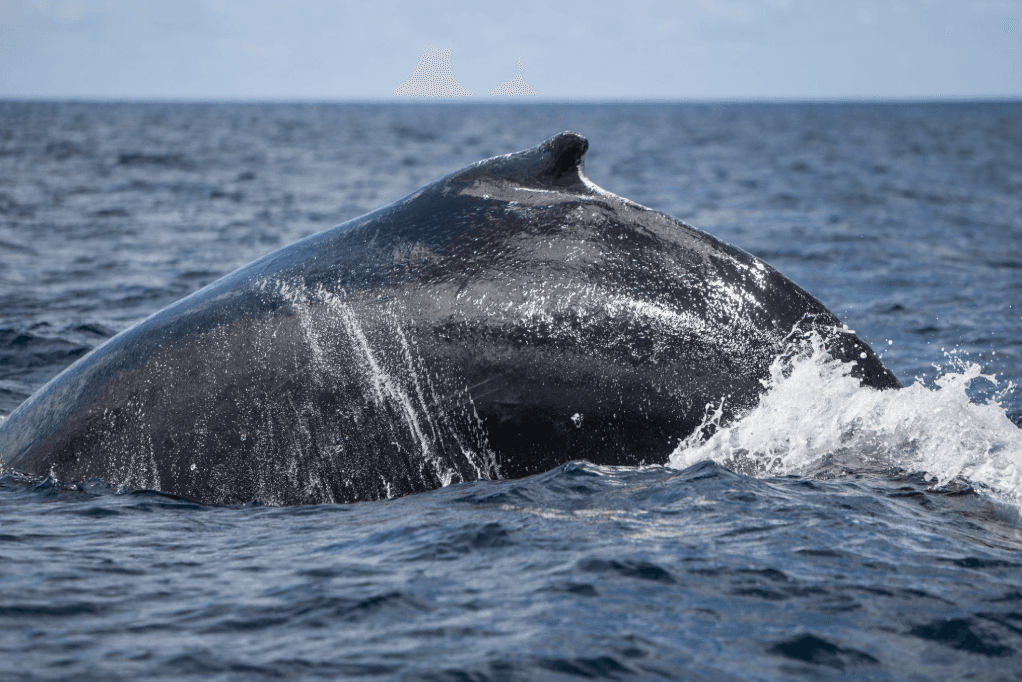
A humpback whale does not always expose a large portion of its body when it surfaces. Sometimes, only a small section of the back or another brief visual feature can be seen.
When the visible area is limited, observers have less information with which to judge the animal’s position and distance.
A small section of a distant whale may blend into the surrounding water, making it difficult to tell whether the animal is nearby or farther away. The next sighting may then seem to occur at a surprising distance.
This is different from the whale necessarily changing its swimming pattern. The apparent change may reflect how much of the animal was visible during each observation.
For related information, readers can explore why humpback whales sometimes show only a small part of their back when surfacing.
6. Changing Light Can Affect Perceived Distance
Lighting influences how clearly an observer can distinguish a whale from the water.
Strong glare may make a distant whale difficult to see, while changes in cloud cover or the direction of sunlight may make the same animal easier to recognize.
When contrast improves, the whale may suddenly become noticeable in a place where passengers had not expected to see it.
This can create the impression that the animal has surfaced farther away or moved unexpectedly.
However, better visibility does not necessarily mean the whale has changed position dramatically. The difference may be caused by the conditions under which it is being observed.
For this reason, lighting and visibility should be considered when interpreting sightings, particularly when the whale is far from the boat.
7. How Waves Can Affect Distance Judgments
Waves continually alter the visible surface of the ocean. A whale may be briefly hidden by a wave crest and become visible again after the obstruction passes.
If observers lose track of the animal during that interval, they may not know whether it remained near its previous position or moved farther away.
When it reappears, the new location may seem unexpectedly distant because the continuous visual sequence was interrupted.
Wave conditions can therefore complicate estimates of movement. They do not, on their own, establish how far a whale has traveled.
This differs from a confirmed observation of the whale moving from one location to another. When the animal is hidden for part of the encounter, the missing information should be acknowledged.
Can Whale Watchers Estimate How Far a Whale Has Traveled?
Sometimes, observers can estimate the change in a whale’s visible position if they have reliable distance measurements, recorded locations, or sufficiently detailed tracking information.
However, simply comparing the apparent positions of two surfacings is not enough to establish the exact distance traveled underwater.
The whale may have changed direction, followed a curved path, or spent part of the interval outside the observer’s field of view. The boat may also have moved during the same period.
It is useful to distinguish three different measurements:
- Distance from the boat: How far away the whale is at a particular moment.
- Displacement between sightings: The straight-line difference between two observed positions.
- Distance traveled: The actual length of the whale’s path between those positions.
These measurements are not interchangeable. A whale can travel along a curved path that is longer than the straight-line distance between its starting and ending points.
For casual whale watching, exact measurements are rarely necessary. Recognizing the limits of visual estimates is often more valuable than attempting to calculate an unsupported distance.
What Should Visitors Do When a Whale Surfaces Far Away?
A distant surfacing can still be an exciting part of a whale-watching trip. Visitors do not need to be close to an animal to appreciate its presence.
Here are several practical ways to make the most of the sighting.
Keep track of the general direction
Remember where the whale was last seen and look across the surrounding area. Avoid assuming that the next surfacing must occur in the same location.
Use the guide’s observations
A knowledgeable guide may help passengers follow the sighting and explain the limitations of judging distance over open water.
Avoid making exact distance claims
Unless a distance has been measured reliably, describe the whale as nearby, distant, or farther from the boat than before rather than assigning an unsupported number.
Be patient
Humpback whales move independently, and their next appearance cannot always be predicted. A distant sighting may offer a different but still memorable perspective.
Respect the whale’s space
A whale surfacing farther away should not automatically prompt a boat to pursue it. Follow the operator’s wildlife-viewing procedures and applicable regulations.
Responsible whale watching prioritizes observation and respect for the animal over obtaining the closest possible view.
How Can Photography Help Explain Distant Surfacing?
Photographs can preserve useful evidence of a whale’s visible position, but they also have limitations.
Camera zoom, cropping, lens choice, and the position of the photographer can change how large or small a whale appears in an image. Two photographs taken from different distances or with different settings may make the same animal look substantially different in size.
For this reason, comparing the apparent size of a whale across photographs does not reliably establish how far it traveled.
A more informative record may include the time of each sighting, the boat’s approximate position when known, the direction in which the whale was seen, and the environmental conditions.
Even with these details, observers should avoid drawing conclusions beyond the available evidence.
Accurate captions also help readers understand the difference between an observed change in position and an interpretation of the whale’s underwater movement.
Why This Matters for Whale Watching in Samaná Bay
Samaná Bay is known as a destination for observing humpback whales during their seasonal presence in Dominican Republic waters. Every encounter, however, unfolds under its own conditions.
The whale may surface nearby or at a distance. Visibility may be clear or limited, and the boat’s position may change throughout the observation.
Understanding distance perception helps visitors approach these experiences with realistic expectations. A whale that surfaces farther away than anticipated is not necessarily behaving unusually, and its appearance does not reveal its exact underwater route.
The most rewarding encounters often come from observing patiently, listening to knowledgeable guides, and appreciating the animal without demanding that it follow a predictable pattern.
Frequently Asked Questions
Why does a humpback whale surface farther away than expected?
It may have continued swimming underwater, changed direction, or surfaced at a different position relative to the boat. The observer may also have misjudged distance over open water.
Does a distant surfacing mean the whale swam quickly?
No. The visible separation between sightings does not reveal the whale’s exact swimming speed. Reliable information about elapsed time, positions, and underwater movement would be needed for a meaningful estimate.
Can a humpback whale change direction underwater?
Yes. A whale can change its direction of movement, but the exact path cannot usually be determined from two brief surface sightings alone.
Why does a whale look smaller when it surfaces farther away?
Objects generally appear smaller as their distance from the observer increases. The whale’s visible size is therefore not a reliable indicator of its actual body size.
Can the boat make a whale appear farther away?
Yes. Changes in the boat’s position can alter the distance and viewing angle between the observer and the whale.
Is a distant whale harder to identify?
Often, yes. A distant animal may reveal fewer recognizable details, making individual identification more difficult. Clear photographs of distinctive features may be needed for reliable identification.
Should a whale-watching boat follow a whale that surfaces farther away?
The boat should follow responsible wildlife-viewing practices and applicable regulations. A distant surfacing does not automatically justify pursuing the animal.
Conclusion
Humpback whales sometimes surface farther away than whale watchers expect because their underwater movements, the boat’s changing position, and the difficulty of judging distance over open water all influence what observers see.
A whale may genuinely have moved, but the apparent distance between sightings does not reveal exactly how far it traveled or how quickly it swam. Lighting, waves, and limited visibility can also affect the experience.
For visitors exploring Samaná Bay, the key is to observe the full context of an encounter rather than judging it from a single moment. Patience, realistic expectations, and responsible wildlife viewing help make even a distant humpback whale sighting worthwhile.

Local explorer & expert guide in Day Trips Near Me.